Cycling Cadence 100 RPM: Is It Right for You?
Jordan MillsNovember 10, 2026 · 13 min read

Cycling Cadence 100 RPM: Is It Right for You?
A cadence of 100 RPM means your pedals complete 100 full revolutions every minute. It sits at the top of the range most cyclists use for steady riding and at the bottom of the range used for sprints and attacks. Whether it suits you depends on the effort, your fitness and how fresh your legs are, and the sections below show you how to find out.
TL;DR
- 100 RPM is 100 full crank revolutions per minute. Most riders settle between 80 and 100 RPM, so 100 is the high end of normal.
- High cadence moves effort from your muscles to your cardiovascular system. That helps in sprints, surges and hard intervals, and it can cost energy over very long efforts.
- Build up in small steps, such as 85, 90, 95, then 100 RPM, in a light enough gear that you do not bounce in the saddle.
- To ride to music, use 100 BPM (one beat per revolution) or 200 BPM (one revolution every two beats).
Table of Contents
- What 100 RPM actually means
- Is 100 RPM a good cadence?
- When 100 RPM helps, and how to use it well
- How to measure your cadence
- How to build up to 100 RPM
- Matching music to 100 RPM
- Our perspective: let the music follow you
- Ride to a beat that adapts to you
- FAQ
- Sources
What 100 RPM actually means
Cadence is how fast you turn the pedals, measured in revolutions per minute. One revolution is one full 360-degree turn of the crank, so at 100 RPM your crank spins around 100 times in a minute. That works out to a little under two pedal strokes per second with each leg.
Cadence is not speed. Two riders can both pedal at 100 RPM and move at very different speeds, because gearing and the force on the pedals decide the rest. Power is cadence multiplied by torque, so you can make the same power with a slower, harder stroke or a faster, lighter one. A slower cadence puts more strain on your muscles, and a higher cadence shifts more of the load to your heart and lungs.
Is 100 RPM a good cadence?
For many riders it is a good cadence for specific jobs, not an all-day default. A good cadence for most cyclists is 80 to 100 RPM, varying from rider to rider. Beginners often turn the pedals at 60 to 85 RPM, experienced riders average 75 to 95 RPM, and pros can exceed 110 RPM in a sprint.
Here is how 100 RPM compares with the ranges you will see quoted:
| Situation | Typical cadence | Where 100 RPM fits |
|---|---|---|
| Beginner riding | 60 to 85 RPM | Well above; build toward it gradually |
| Endurance riding | 70 to 90 RPM | Above the usual range |
| Time trials and racing | 90 to 100 RPM | Top of the range |
| Sprints, attacks, surges | 100 to 120 RPM | Bottom of the range |
The ranges come from research summarized by Bicycling, which reports 100 to 120 RPM as the most efficient range for sprint power, 90 to 100 for time trials and 70 to 90 for endurance riding.
What the pros do
Professional cadence is high, but not always 100. Strava data from the 2024 Olympic women’s road race in Paris showed Kristen Faulkner averaging 95 RPM, Lotte Kopecky 93 and Blanka Vas 96. So even in an Olympic road race, the averages sat just under 100, with higher bursts in the attacks and the finish.
There is also a counterexample. MyWhoosh coach Si Bradeley notes that pro road racing usually runs at 90 to 100 RPM, while some top esports riders go as low as 60 RPM because they are so strong and powerful. Your best cadence is personal.
Your own sweet spot
Research by Whitty and colleagues found that most cyclists naturally gravitate to 80 to 100 RPM, and that preferred cadence tends to rise with experience and fitness. Dr. Xavier Disley of AeroCoach, who has studied cadence with elite riders, says most cyclists self-select a near-optimal cadence in lab testing, and that it is worth experimenting because no single cadence is best in every situation.
Biomechanics modeling points the same way. Riders with more fast-twitch fibers tend to prefer higher cadences, slow-twitch riders are a bit more economical lower down, and there is a broad efficiency plateau between 60 and 100 RPM. If 100 RPM feels natural to you, that is useful information. If it does not yet, that is normal too.
When 100 RPM helps, and how to use it well
Think of 100 RPM as a tool you pick up for the right moment. The research suggests clear places where it pays off, and a few places where you should dial it back.
Where it works best
- Racing and time trial efforts. 90 to 100 RPM suits most racing and time trial situations where power production matters most.
- Hard intervals and accelerations. Cadences of 95 to 110 RPM are usually reserved for VO2 max and anaerobic capacity intervals and sprint workouts.
- Saving your legs. High cadence shifts the stress of hard efforts toward the aerobic system, which is more fatigue resistant than skeletal muscle.
- Skill work. Short, low-power spins at 100 to 120 RPM in easy zones can improve neuromuscular coordination and comfort.
There is a comfort angle as well. Experiments have shown that pushing a big gear at a low cadence is more likely to cause muscle strain and soreness than reaching the same speed at a faster cadence with less load. Knee pain is often linked to an excessively low cadence.
Matching cadence to the length of the effort
Laboratory work shows why duration matters. In one study, competitive cyclists rode 180 minutes at 100 RPM and at 80 RPM. At 100 RPM they had a higher heart rate, oxygen uptake and blood lactate, and their later maximal power was 327 W versus 362 W after riding at 80 RPM. The authors concluded that a lower, more economical cadence over prolonged riding may help you perform better later in a race.
Going too high has a ceiling too. In another study, maximal power was about 9% lower at 120 RPM than at 80 and 100 RPM (335 W versus 363 W and 370 W), and the ventilatory anaerobic threshold fell 11%. In that data, 100 RPM held up well and 120 RPM did not.

Fatigue changes the picture as well. A 2025 Journal of Sports Sciences study found that professionals held higher cadences at a given power when fresh, but as they tired, cadence dropped, and late-race power losses were explained more by falling cadence than by torque. In practice, your ideal cadence drifts downward as you tire, so a number that feels right at minute 10 may be wrong at minute 150.
Beginners and recreational riders should read the results with their own fitness in mind. One Journal of Strength and Conditioning Research study of recreational women in an 8 km time trial found that 60 RPM produced better efficiency, lower heart rates and faster times than 100 RPM. The takeaway is to reserve 100 RPM for the efforts that call for it, and let your steady riding settle where it is comfortable.
Watch your body
Too fast can feel as wrong as too slow. A cadence that is too high can cause pelvis rocking and lower-back pain. If you are bouncing in the saddle, shift to a slightly heavier gear or ease the cadence down a few RPM. Persistent knee or back pain while riding is a reason to see a physical therapist or a qualified bike fitter, not to push through.
How to measure your cadence
You can start with no equipment. The simplest method is to count how many times your legs go up and down in a minute. For a precise record, use a cadence sensor on the left-side chainstay with a magnet on the crank arm, or a power meter with built-in cadence, which sends data to your bike computer.

Indoors it is easier. Most smart trainers collect cadence, and most virtual training programs show it on screen. Outdoors you need a sensor on a pedal or crank arm, or a pedal-based power sensor, connected to a cycling computer. If you want a structured way to find your number indoors, our 20 to 30 minute indoor cadence test walks you through it, and our piece on cadence versus heart rate explains how the two move together.
How to build up to 100 RPM
Do not jump from 70 to 100 in one ride. Si Bradeley suggests small increases: if you naturally pedal at 65 RPM, get comfortable at 80 before going to 90. Indoors, it becomes obvious when you have gone too high, because you start to bounce and lose control.
Three drills from published coaching guidance cover most needs:
- The step ladder. Find a gear that lets you work at 75% of your maximum heart rate, or 7 out of 10 effort. Then progress from 85 RPM to 90, 95 and 100 in one-minute steps, dropping back to 85 and adjusting resistance to hold your target heart rate.
- Endurance spinning. Raise your cadence 3 to 5 RPM and hold it for five minutes. If your heart rate climbs by more than a few beats per minute, reduce your cadence, pedal normally for a few minutes, then repeat.
- Fast pedal. Use a light gear, keep your upper body calm and pedal as fast as you can without bouncing. Start with three to five one-minute efforts with two minutes of moderate-cadence recovery, then progress to three-minute efforts with five minutes of recovery.
For more variety, see our cadence drills guide and the 4-week cadence plan. Riding with others also gives you a steady pace to match, and you can find local group rides to practice in company.
Matching music to 100 RPM
Music is one of the simplest ways to hold a cadence without staring at a screen. The math is short: set your playlist’s BPM equal to your RPM (one beat per revolution), or double it (one revolution every two beats). For sprints at 100 to 110 RPM, the 1:1 ratio usually feels cleaner.
| Target cadence | 1:1 mapping | 2:1 mapping |
|---|---|---|
| 90 RPM | 90 BPM | 180 BPM |
| 100 RPM | 100 BPM | 200 BPM |
| 110 RPM | 110 BPM | 220 BPM |
The 2:1 option exists because most popular tracks are not at 100 BPM. The Indoor Cycling Association sorts songs into cadence-range playlists and notes that many pop and dance tracks fall between 120 and 140 BPM. That is why songs for 60 to 70 RPM climbs are plentiful and 100-plus playlists are harder to fill. Half-time and double-time are your workaround: coach Marianne Rizkallah suggests halving and doubling BPM and building a class playlist from lower BPM songs up to 100, then winding down again.
Synchronized music also pays off in the saddle. A study reported that indoor cycling works better with music people can synchronize with, and that songs at roughly 120 to 150 BPM help keep heart rates up and riders pedaling to the beat.
For step-by-step help, read our guides on syncing songs to your RPM, the BPM divided by two method and cadence-matched sprint music.
Our perspective: let the music follow you
Most cyclists we talk to treat cadence and music as two separate problems. They build a playlist, then try to ride to it. We think it works better the other way around: your effort sets the tempo, and the music follows.
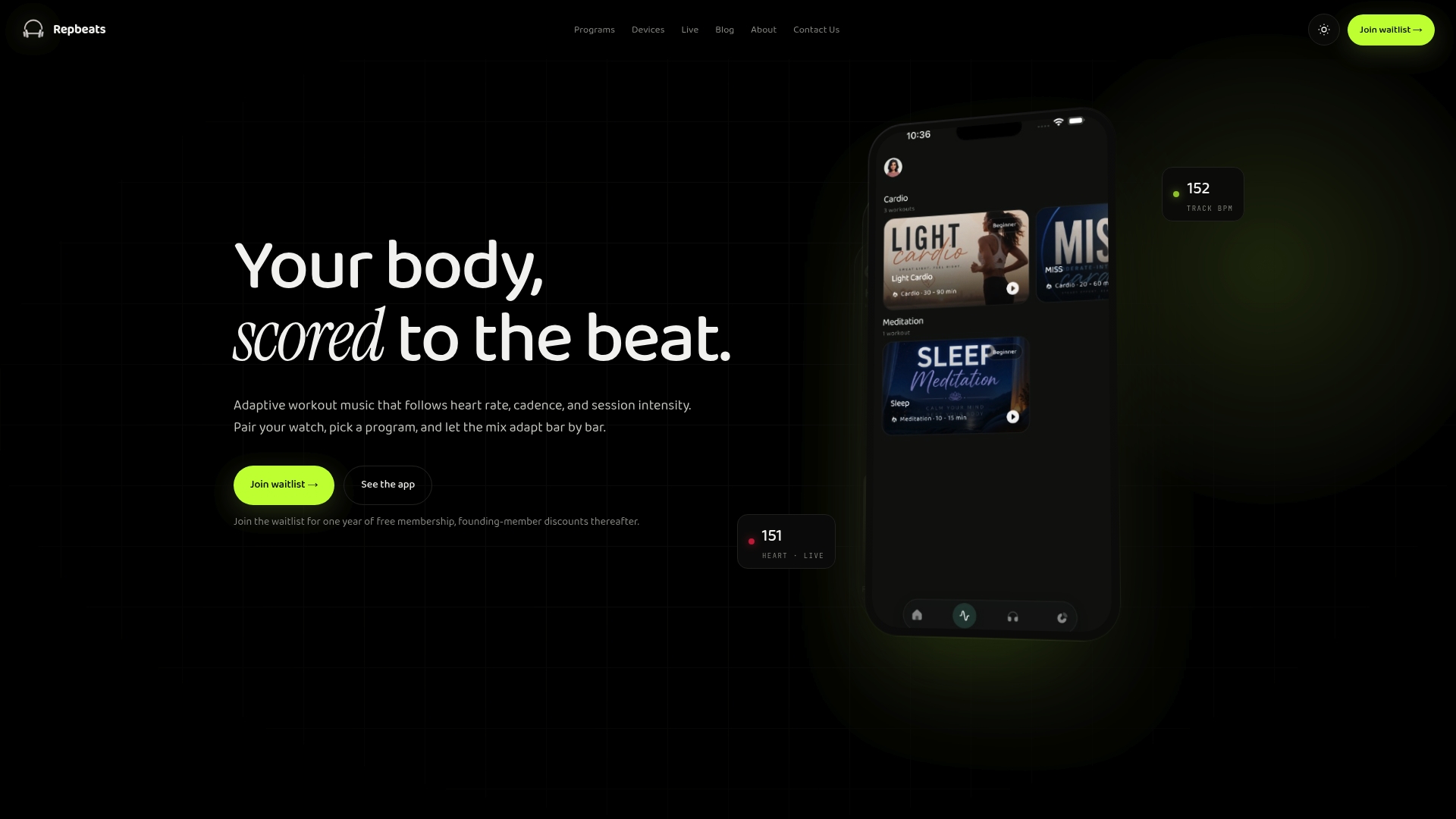
That is the idea behind Repbeats. Our app is designed to read live data from wearables such as Apple Watch and Fitbit, and to adapt the music’s BPM to your heart rate, cadence and session intensity. Our auto-DJ updates the tempo every bar, so the beat shifts as your effort shifts, with no manual playlist juggling.
For a rider working toward 100 RPM, that means the beat can sit where you want to be while you build up in small steps, and it can move with you through sprints, recoveries and the long steady blocks in between. The point is a rhythm that supports each phase of the ride.
We also keep access limited to workout data only, which matters when you wear a device all day.
Jordan Mills
Ride to a beat that adapts to you
If you want to practice 100 RPM efforts with a soundtrack that keeps pace, the Repbeats app is built for that. It synchronizes music tempo to your heart rate, cadence and session intensity using data from wearables like Apple Watch and Fitbit, and it includes real-time music control, library search and program scheduling. Our waitlist launch includes a free year.
You can also explore Repbeats to see how adaptive music works for cycling, running and meditation sessions.
FAQ
Is 100 RPM too fast for cycling?
Not for the right effort. 100 RPM sits at the top of the commonly recommended 80 to 100 RPM range and the bottom of the 100 to 120 RPM range used for sprints and attacks. It is a strong choice for intervals, surges and some racing efforts. For long steady rides, many riders do better a little lower, and the right number is the one you can hold without bouncing.
What is a good RPM for a bike?
For most cyclists, 80 to 100 RPM is a good range, with beginners often at 60 to 85 and experienced riders averaging 75 to 95. Pick the cadence at which your breathing and legs both feel manageable. Because your best cadence shifts with fitness, effort and fatigue, test it across a few rides.
Is a cadence of 200 too high?
For pedaling, yes. Even elite sprinters are described at around 110 RPM or a little more, and in one study maximal power dropped at 120 RPM. If you see 200 in a music context, it is probably a BPM figure: 200 BPM is the 2:1 match for a 100 RPM cadence.
How do I match music to 100 RPM?
Use songs at 100 BPM for one beat per revolution, or songs at 200 BPM for one revolution every two beats. Many popular tracks run 120 to 140 BPM, so you may need to mix tempos or use half-time and double-time. An adaptive app can adjust the tempo for you as your cadence changes.
Sources
- What Is Cadence? Plus, Why It Matters and How to Improve (Bicycling)
- What is cycling cadence and how fast should you pedal? (BikeRadar)
- Cycling Cadence: What Is It, What’s Most Efficient (TrainerRoad)
- Cycling Cadence: Economy, Efficiency and How to Train (TrainRight)
- Optimal Cadence for Cyclists: What the Research Says
- Effects of cadence on aerobic capacity following a prolonged, varied-intensity cycling trial (PubMed)
- Performance at high pedaling cadences in well-trained cyclists (Medicine & Science in Sports & Exercise)
- Cadence Drills: Benefits and How to Incorporate Into Your Training (Bicycling)
- Spin Bike RPM To BPM Conversion Chart
- All the 6-Minute Songs You’ll Ever Need (Indoor Cycling Association)
- Ultimate workout music guide